- Home
- Government
- Boards & Committees
- Boards & Committees M-S
- Natural Resources Commission
- Subcommittees
- Heywood Meadow Stewardship Committee
Heywood Meadow Stewardship Committee
Meetings
- 9 a.m.
- The 2nd Thursday of every month
- First Floor Meeting Room
141 Keyes Road
Concord, MA 01742
Agendas and Minutes
Agendas are available prior to meetings. Minutes are available following approval.
View Agendas and Minutes
Heywood Meadow, an Overview
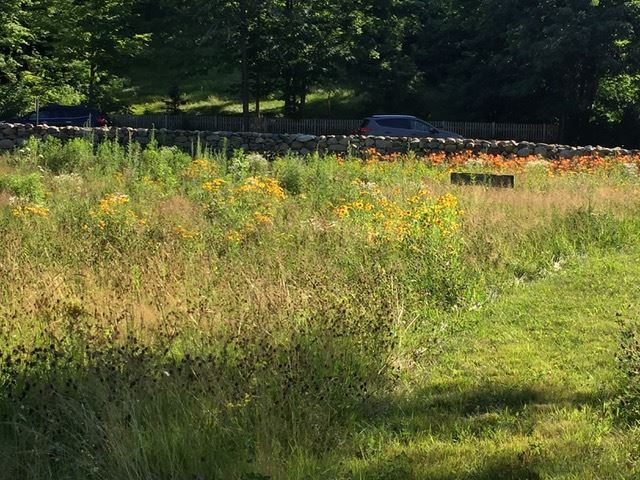
Heywood Meadow is a landscape of open meadows, woods, the Mill Brook, and its wetlands. It is located between Lexington Road and Walden Street and bisected by Heywood Street. This area is part of a much larger meadow that for hundreds of years extended along the Mill Brook. Heywood Meadow is now valued as a unique open space prominently located near the center of town. The Meadow is both a significant natural resource and a cultural and historic landscape evoking Concord’s colonial past while providing the setting for the historic homes near the Meadow.
The wetlands and woods along the Mill Brook near the center of town have a long human history, starting with the Nipmuc who called the Concord area Musketaquid, the ‘grassy river’. When English explorers first visited Musketaquid, they noted the extensive meadows, the network of indigenous peoples’ trails, and the small ‘planting grounds’ in the area. Fish and game were abundant. With a land grant from the English king, a new town center was established along the Mill Brook in 1635, with houses clustered around the Meeting House. In 1636, the colonists straightened and dammed the brook for their mill to create the Mill Pond. The Pond covered a portion of the west side of Heywood Meadow until 1828 when it was drained. Most of the earliest house lots were laid out along the north side of Bay Road (now Lexington Road), facing south, with their gardens and orchards nearby and their woodlots on the adjacent hillside. The fertile, low-lying area along the Mill Brook was used primarily for pasture as meadow grass was plentiful and water readily available.
On April 19, 1775, the British retreated past the Meadow, skirmishing with the rebelling colonists along Lexington Road, earning it the name Battle Road. The area and Heywood Street are named after Dr. Abiel Heywood, who in 1822 began acquiring an extensive property at 105 Lexington Road, known today as the Beaton-Heywood house. In the mid 19th century, the Meadow was well‑loved by the Transcendentalist authors who lived in Concord: Ralph Waldo Emerson, who lived next to the Meadow in what is now known as the Emerson House, Henry David Thoreau, who walked the Meadow often, and the Alcotts, whose house is close by on Lexington Road.
Despite a few structures which have since been removed, Heywood Meadow has remained largely open and served as an orchard, vegetable garden, or hay field until after World War II when it was no longer used for agriculture. It was ‘vacant’ land, attracting proposals for new fire and police stations in the 1950s, a county courthouse in the 1960s, and an expanded visitor information center in the 1990s. By 1949, the town had started to acquire some 130 acres upstream from Heywood Street, along the Mill Brook valley, as a flood control measure. The early decisions not to build on Heywood Meadow were made largely out of concern for the Mill Brook, in recognition of the importance of the brook and its associated wetlands for flood storage. The brook banks became wooded and smaller areas were kept mowed.
With increased development putting pressure on the town center and the creation of Minute Man National Historical Park in 1959, Concord was aware of the need to document and protect its historic resources. In 1968, Middlesex County attempted to take the land by eminent domain for the courthouse. That controversy pointed out the vulnerability of the meadow and catalyzed support for its protection; in 1969 the town transferred control of the Meadow east of Heywood Street to the Natural Resources Commission for permanent conservation.
In 1985, Lots 1 and 2 on the west side of Heywood Street were threatened with development. A combination of public and private funds was raised to buy the land which was subsequently placed in conservation. In 1995, the adjacent Lot 3 was designated as the site for the Town Visitor’s Center; after a multi-year debate an alternative Concord center site for the Visitors Center was offered by Middlesex Bank and private funds were raised to buy Lot 3. This final parcel of Heywood Meadow was deeded to the Natural Resources Commission, thereby placing the entire 8.4-acre area under permanent conservation. Heywood Meadow now includes the two open fields, the wooded wetlands on both sides of the Mill Brook, Ford Park, and the parcel along Walden Street.
Since 1960, Heywood Meadow has been included in the Monument Square/Lexington Road Historic District. In 1977, the American Mile National Register District was established, and it also includes Heywood Meadow.
While development of the land has been averted, incremental change has altered the character of the landscape. Houses, traffic, and signage increasingly intrude on the strong sense of place. The State’s Wetland and Rivers Protection Acts protect tree growth along the stream’s edge, closing off historic vistas, while greatly increasing Mill Brook and adjacent lands as a wildlife corridor.
The Heywood Meadow Stewardship Committee, established by the Natural Resources Commission in 2000, has overseen the management and preservation of the meadow, its trees, and its boundaries (walls). Working with the Natural Resources Division, the Committee has completed a decade-long project of rebuilding the historic stone walls along Lexington Road; removed an historically inappropriate wall on Heywood Street; battled invasive plants in the fields and the woods; reduced the amount of mowing to encourage flowering native species; put up and maintained a number of well-used bluebird houses; and planted many desirable native pollinator and bird-friendly plants in the fields.